



A founder I talked to last year paid a reputable agency $60,000 for a clean, bug-free app. The architecture was solid, the code passed every test, and it shipped on time.
Then almost nobody used it.
Startups fail at software because they pay to build before they have proof anyone wants the product. The code is rarely what breaks.
This founder spent his whole budget answering a question he had never put to a single customer. By the time the answer came back, the money was gone.
He could have had that answer for almost nothing, weeks before he signed the contract.
Below is where the software spend actually goes wrong, what a custom build really costs, and how to prove people will pay before you commit the budget.
Many startups fail at software because they build a product nobody needs. The project also takes longer and costs more than planned. Running out of money gets recorded as the reason the startup closed. The money was already spent on a product nobody had asked for.
Key Takeaways
- Your app can work perfectly and still have no users.
- Paying an agency to build your idea is an expensive way to find out whether anyone wants it.
- Most of the extra cost comes from changes made after the build starts.
- If you cannot judge a technical decision, your developer makes it for you.
- One customer paying you tells you more than months of building.
- Test demand first, and a wrong idea costs you a week instead of your whole budget.
Key Reasons Startups Fail at Software
Most software failures start with the founder’s early choices. What to build, who will buy it, and how big the first version should be all get decided before a developer is hired. If those choices are wrong, even a well-built app launches to no users.
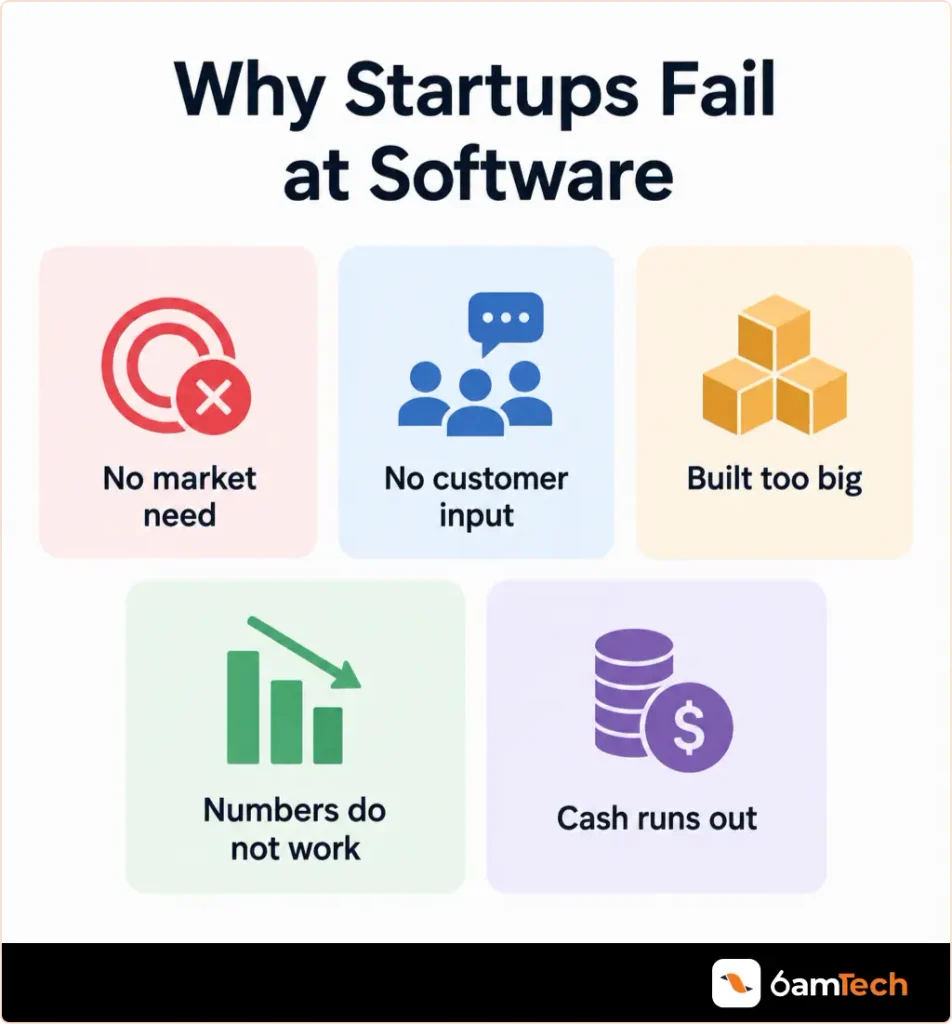
CB Insights reviewed 431 companies that shut down and found that no market need was the most common root cause, at 43%. None of those failures started in the code.
Each one traces back to a decision the founder made before the build began.
Lack of Market Need
The most common reason a startup’s software fails is that nobody needed it. The founder noticed a problem, assumed others felt it the same way, and paid to solve it.
Quiet problems rarely turn into paid ones. People work around them for free, and they keep working around them after the app launches.
Ignoring Customer Feedback
The second reason is building on belief instead of evidence. Many Founders test their idea inside their own team, where everyone already agrees with it.
Real buyers say something different. Ask them early, and you can still change the plan.
Overbuilding the First Version
An MVP is the smallest version of a product that answers one question: will anyone pay for this?
Founders skip that version and order the full platform instead.
A first build does not need:
- Capacity for ten thousand users on day one
- Features for customers who have not arrived
- Integrations nobody has asked for yet
Each of those adds months to the timeline and a large share of the invoice.
Losing Money on Every Order
Some products work perfectly and still lose money on every order. Delivery, payment, and support costs eat the margin, so more orders make the hole deeper. The numbers get checked after the orders start coming in.
Running Out of Cash
Running out of cash is often listed as the reason a startup closed. But the cash usually runs out because of the mistakes above: no market need, no customer input, an oversized first build, and losses on every order.
A startup can spend most of its budget on development. If the launch takes longer than planned, the remaining cash can disappear quickly. The startup may run out of money before the product generates enough revenue.
Most of these mistakes start before customers have shown that they want the product. Once development begins, the founder faces new decisions about hiring, spending, and changes to the plan. These decisions determine how effectively the remaining budget is used.
Key Challenges Startups Face in Software Development
The hardest challenges in software development sit outside the code. A startup has limited money, a small team, and a launch date to meet. Good developers cost more than the budget allows.
Code written in a rush to meet that date causes problems later. None of these challenges is a coding problem. Every one is a choice the founder makes, usually for the first time.
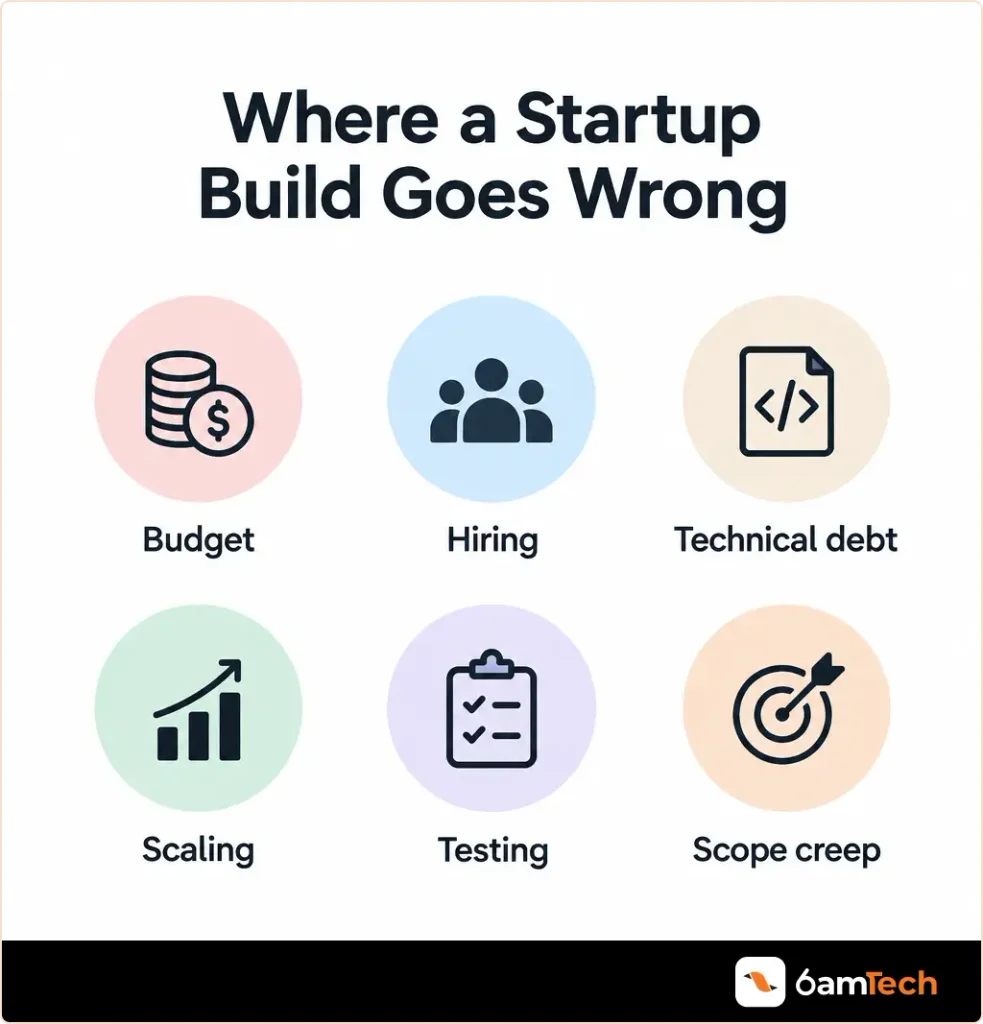
These are the problems that show up in almost every startup build.
Limited Budget and Resources
A startup builds with a fixed amount of money and very few people. Design, testing, support, and hosting all come out of the same budget. One person usually covers two or three of those jobs.
The pressure shows up in small choices. Paid tools get swapped for free ones that take longer to use. Testing goes to whoever is free that day. Work that needs a specialist goes to whoever is available.
Hiring and Keeping Good Developers
Good developers cost more than most startups can pay, and large tech companies pay more for the same people.
A founder who cannot read code cannot judge who writes it well. The choice usually comes down to a portfolio. A portfolio shows a finished app. It does not show who built which part.
Developers also leave startups for better pay or a safer job. Each exit takes product knowledge with it.
Technical Debt in a Rushed Build
Technical debt is the extra work created by building fast. A developer copies the same payment code into every screen that needs it, because copying is quicker than writing it once properly.
The app works. Six months later, the payment rules change. One small fix now has to be repeated everywhere the code was copied.
The debt piles up in four ways:
- Quick fixes
- Skipped tests
- Copied code
- Missing notes
The hard part for a founder is that none of it is visible. The app looks fine. Development keeps slowing down, and the team cannot explain why in terms the founder can check.
Scalability and Technical Challenges
Software built quickly for a handful of users starts to break when real traffic arrives. Pages take longer to load. Payments time out. Orders sit waiting.
Fixing it under load is the worst version of the job, since the site is live and customers are watching.
Cutting Testing to Meet a Launch Date
When the launch date is close, testing is the first work a founder drops. Testing produces no new screens and no new features, so cutting it looks like the cheapest way to save time.
The bugs do not disappear. They move to the people who download the app first. Early users are the ones most likely to recommend a new product. They are also the quickest to leave, because nothing is holding them there yet.
Scope Creep After the Build Starts
Early feedback always changes the plan. Every change puts pressure on work the team has already finished. Work added after the build starts is what people call scope creep.
Small changes can seem harmless. A new form field, an extra integration, or one more screen can add development time. Over several months, those hours add up and push the project beyond the approved budget.
None of these are engineering problems. Each one is the founder’s decision. And each one gets made before there is any proof the product should exist.
Examples of Startups That Failed at Software
Startups fail at software when the money goes into the build before anyone confirms the product is wanted. The three companies below show what that looks like. All of them shipped working products, and none of them were short on money or talent.
Quibi
A short-form video app that raised around $1.75 billion and shut down six months after launch.
Why it failed:
- The product strategy put the money into one patented feature. Video flipped between vertical and horizontal when you turned the phone.
- The app could not cast to a TV or let anyone clip and share a moment.
- The app had no feature flexibility, so none of that could be added once the complaints started.
The founders picked those features. The developers built what they were asked to build.
Fast
A one-click checkout company that raised about $124 million and closed in 2022.
Why it failed:
- Chrome and Safari already remembered card details for free, so shoppers had nothing to gain from Fast.
- Shopify merchants already had Shop Pay, so few had a reason to add another button.
- For every $1 the software earned, the company spent roughly $166.
- Annual revenue stayed under a reported $1 million while burn ran near $10 million a month.
Nothing was wrong with the code. The demand was never there to begin with.
Olive AI
A healthcare automation company that raised over $850 million and shut down in November 2023.
Why it failed:
- The company sold hospitals AI software that promised to cut paperwork and admin costs.
- eMarketer reported the savings figures came from rough guesses rather than measured results.
- Hospitals got back far less than the sales pitch had promised.
- The company kept adding new products on top of a core product that did not work.
The software was the product. It never did the job it was sold to do.
Quibi, Fast, and Olive AI all spent the money before anyone confirmed the product was wanted. Checking first takes a few weeks and costs almost nothing.
How to Validate a Startup Idea Before You Pay for Software
You validate a startup idea by proving people will pay for it before any money goes into software. The work takes a few weeks and costs almost nothing.
A founder who does it walks into a developer meeting knowing who buys, at what price, and what those buyers need on day one.
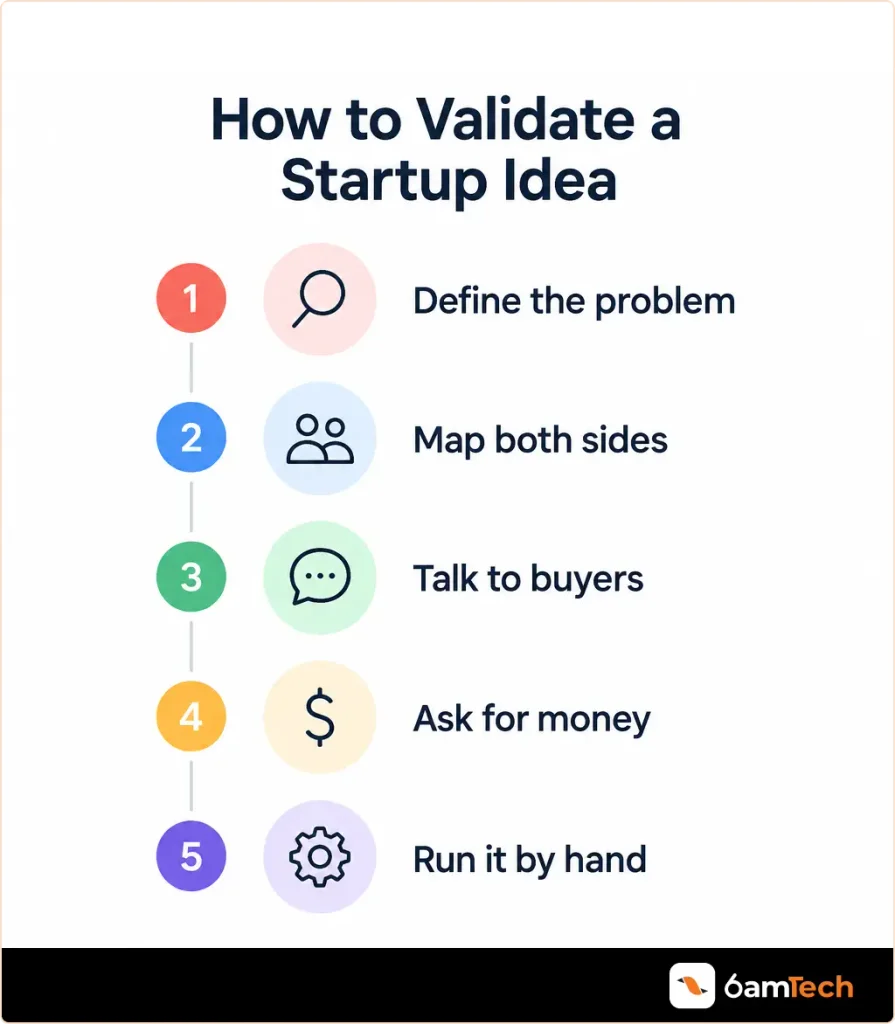
The order of the work is what makes it work. A real problem makes the conversations worth having. Honest conversations show whether anyone will pay. A paid order makes a small live launch worth running.
Define the Problem Your Startup Solves
Write the problem in one plain sentence without naming your app. Then check whether it still makes sense on its own.
A founder starts with the solution. Build a delivery app. Build a booking tool. Turn that around and describe what the customer deals with today, what they do about it, and what that costs them.
If the problem only makes sense once you describe your product, there is no problem yet.
Validate Both Sides of a Two-Sided Marketplace
Many startups need two groups to show up. Buyers and sellers. Riders and drivers. Patients and clinics. Proof from one side tells you nothing about the other.
One side is always harder, and it is usually supply. Validate that side first.
Run Customer Interviews Before You Build
Talk to people who have the problem until the answers start repeating. Steve Blank, who built the customer development method, calls this getting out of the building, because the answers are never at your desk.
How you ask decides what you learn. A leading question buys you a polite answer.
Ask:
- How do you handle this today
- What did that cost you the last time
- Walk me through the last time it went wrong
Never ask:
- Would you use an app that does this
- Do you think this is a good idea
- Would you pay for this
Test Willingness to Pay With Real Money
A compliment is free, so it proves nothing. Ask for something small that costs the customer something to give.
- A deposit: Money down against a delivery date you name
- A pre-order: Payment for a slot in the first batch
- A signed letter of intent: For business buyers who cannot pay yet
Refund the money if you do not ship. Then count only the people who paid, not the ones who said they liked the idea.
For example, “Fast” was a company that built a one-click checkout button for online stores. Many store owners showed interest, but very few added the button to their websites. Interest did not turn into use, and the company shut down.
Run It by Hand Before Automating
Do the job by hand for your first customers before anything is automated. A booking tool means taking bookings over the phone. A hiring platform means matching candidates yourself. A course marketplace means emailing the lessons one by one.
Founders call this a concierge MVP.
Doing the work yourself shows you which parts of the job actually need software. Every step that slows you down is worth automating. Every step you expected to need and never used is one you would have paid to build for nothing.
After these steps, you will know three things a developer needs before the build starts:
- Who your buyers are, and how many of them have paid
- What price they accepted for the product
- Which tasks slow you down as orders grow, since those are the parts worth automating
Most founders start a build without this information. For a step-by-step guide, see how to validate a startup idea.
The next decision is whether to build from nothing or start with software that already exists.
Custom Software vs Ready-Made Software for Startups
Every founder reaches this decision at the same point. The idea has been tested, and people have paid for it. Now the founder needs to build the software. There are two common ways to do that, and each approach has a different cost and timeline.
Custom Software
Custom software is software built from scratch for one business, to that business’s own specification. A development team designs, codes, and tests every part of it, and the business owns the result.
You start from zero, so you pay to build every part of the product. You get exactly what you asked for. You also wait months to see it working.
Ready-Made Software
Ready-made software is a pre-built product that many businesses license and run. The core work is already built and tested, so you buy it, set it up, and change the parts that need changing.
You launch in weeks instead of months. You get what the product already does. Anything outside that depends on the license, and full source code is what makes real changes possible.
The two options differ on more than price.
| What to compare | Custom build | Ready-made platform |
| Time to launch | Months | Weeks |
| What you pay | Full cost upfront | One-time license or a subscription |
| What you can change | Anything, at a price | Depends on the license. Source code means full control |
| Who maintains it | You hire for it | The provider maintains the core |
| Source code | Yours from the start | Comes with most one-time licenses, rarely with a subscription |
| Best suited to | Software nobody else sells | Standard flows other businesses already run |
Also Read: eCommerce Website Security – Best Practices for Your eCommerce Business
Which One Fits Your Startup
Buy ready-made unless the software itself is what customers are paying for.
There is a simple way to check. Put your app next to a competitor’s app, then ask what a customer would lose by using the other one.
If you can name something specific, build it. That might be a way of matching buyers to sellers that nobody else offers, or a pricing method that works differently. No existing product will have it, so building it is the only option.
If you cannot name anything, buy it. Ordering, booking, payments, and tracking work the same way in every business. Building them again does not change anything for the customer.
Both options come with a price. The next section covers what each one costs.
What Does It Cost to Build Software for a Startup
A custom build for a first product runs into tens of thousands of dollars, and that is usually a founder’s whole budget. Ready-made software is priced before you buy it, so the two are worth putting side by side.
Software has no fixed price. A custom build is priced on how big the product is, how long it takes, and where the team sits.
Ready-made software is priced before you buy it, so the two are worth putting side by side.
| What you pay for | Custom build | Ready-made |
| Size of a typical first build | Roughly 120 to 150 features and screens | Already built |
| Effort per function point | 10.5 to 13.2 hours | Not applicable |
| Time to deliver | 4 to 7 months | Days to set up |
| Team cost per hour (EU) | €46.30 on average, from €21.70 to €58.00 | Included in the price |
| Team cost per hour (US) | $71.20 on average, before overhead | Included in the price |
| Price per function point | €600 to €1,000 on a small project | One price for the whole product |
| Overrun risk | 18% of projects exceed budget by over 50% | No overrun, the work is done |
| Cost after launch | 79% of IT spending goes to running software | Provider maintains the core |
Sources: ISBSG, Eurostat, BLS, Flyvbjerg (Sagepub), and GAO.
Add those figures up, and a startup’s first build lands somewhere near $65,000 to $110,000. The overruns and the running costs in the last two rows come on top of that.
A ready-made license usually costs a few hundred dollars. Setup takes weeks instead of months, so a founder can start taking orders much sooner.
The platform also gives you a working base that you can customize to fit your business. In this video, Amika, an entrepreneur and one of our clients, shares his experience customizing his online marketplace with 6Valley, 6amTech’s ready-made eCommerce platform.
Conclusion
The founder in the $60,000 story did not fail because his developers were bad. He failed because he answered an expensive question before he tried the free one.
Most startups fail at software for two reasons. They build a product before checking if people need it. Then the build takes longer and costs more than planned.
The safest first step is to test demand before you pay for a build. Talk to buyers, ask a few of them to pay, and do the work by hand at first.
Once the test shows real demand, the next step is getting the software. A ready-made platform can help you launch in weeks instead of months.
Choose a platform that includes full source code and customization support, so the platform can grow with new features as customers ask for them. Build custom software only for the features no existing product offers.
Frequently Asked Questions
Do 90% of startups really fail?
No. The 90% figure only holds if failure means never returning venture-scale money to investors. By the plain meaning of closing down, about half of new businesses are still trading at year five. The number is repeated because it sounds alarming.
What app development mistakes do startups make most often?
The most common tech mistakes are building before testing demand, letting scope grow after work starts, and asking for a platform sized for ten thousand users on day one. A fourth is picking an agency on price and portfolio. What matters more is how that agency handles a change to the plan. None of these is a coding error.
How much does it cost to validate a startup idea before building?
Almost nothing. Twenty conversations with buyers cost you time and a few coffees. A pre-order costs a payment link. Running the service by hand costs a spreadsheet and a phone. A custom build starts around $10,000.
How long does it take to validate a startup idea?
Two to four weeks for most businesses. A week to run twenty customer conversations. Another week to ask for money and see who actually pays. Then a week or two running the service by hand. A build takes six months to reach the same answer.
Can a non-technical founder build a startup app?
Yes, and most do. The hard part is judging technical calls, so developers usually build whatever is easiest. A technical advisor covers that for less than the cost of one wrong feature. Ready-made software removes most of those calls, because the core decisions are already made.
Should a startup use ready-made software or hire developers?
Use ready-made software unless the software itself is what customers pay for. Ordering, delivery, payments, and tracking already work the same way in thousands of businesses. Building them again costs months and changes nothing for the customer.
What happens if my app launches and nobody uses it?
Your budget is gone, and the app earns nothing, so the business stalls until you find out why. Ask the people you built it for what they do instead. The reason is usually that the problem was smaller than it looked, the timing was early, or the app did not fit how they work. Rebuilding without that answer spends a second budget on the same lesson.
What is the 80/20 rule for startups?
The 80/20 rule, also called the Pareto principle, says a small share of effort creates most of the results. For a startup’s software, a few core features usually do most of the work for customers. Build those first. Add the rest only after paying users ask for them.
How do you know an MVP is ready to launch?
An MVP is ready when a real user can finish the main task from start to end and pay for it. The core flow should be tested and stable. Extra features, design polish, and support for thousands of users can wait until people start using the product.
How many startups fail in their first year?
About one in five new businesses in the US close within their first year, according to the Bureau of Labor Statistics. Most of these closures come down to cash. A startup that keeps money aside after launch has more time to find paying customers.