











Imagine running your online store while an AI handles customer inquiries, recommends products, updates inventory, adjusts prices, recovers abandoned carts, and even spots potential fraud, all without constant supervision.
That is exactly what AI agents are making possible.
Unlike traditional automation tools that simply follow predefined rules, AI agents can understand context, make decisions, and complete multi-step tasks with minimal human input. As customer expectations continue to rise and competition grows, businesses are using AI agents to deliver faster support, personalized shopping experiences, and more efficient operations.
In this guide, we’ll explore the best AI agents for eCommerce and help you find the right solution for your online store. Whether you’re a small business looking to automate repetitive tasks or an enterprise aiming to optimize operations at scale, this guide will help you make an informed decision.
An AI agent for eCommerce is an autonomous software system that uses large language models (LLMs) to understand user intent, make context-aware decisions, and complete multi-step tasks automatically. It can work across online store platforms without requiring constant human supervision.
Key Takeaways
- AI agents are transforming eCommerce by automating customer support, sales, marketing, and daily business workflows.
- The right AI agent depends on your business goals. Choose a solution based on whether you need better support, higher conversions, or improved operations.
- The best AI agents connect with eCommerce platforms, CRM, helpdesks, and other business tools to take real actions.
- Evaluate automation, security, customization, and analytics to ensure the AI agent can scale with your business and deliver measurable value.
Why AI Agents Are Becoming Essential for Online Stores
Every online store has tasks that consume time but add little strategic value: answering repetitive customer questions, updating inventory, processing returns, monitoring prices, and managing orders. As your business grows, these tasks become harder to handle manually.
eCommerce AI support agents automate these workflows, helping businesses respond faster, reduce operational costs, minimize errors, and free up teams to focus on growth. They also enable personalized customer experiences at scale by making decisions based on real-time data.
This growing value is driving rapid adoption. The AI agents in the eCommerce market are projected to grow by USD 4.2 billion between 2024 and 2029, at a 39.7% CAGR, fueled by the demand for automation, hyper-personalization, and better customer experiences.
Types of eCommerce AI Agents
eCommerce AI agents are not limited to customer support. They now help businesses manage customer interactions, optimize operations, and improve marketing performance. Based on their role and purpose, eCommerce AI agents can be divided into three main categories:
Customer-Facing AI Agent
These agents interact directly with shoppers throughout the buying journey. They answer product questions, recommend suitable items, assist with orders, manage returns, and resolve common issues. Many can now handle complete customer conversations without human involvement.
Operational AI Agents
These agents work behind the scenes to improve business operations. They monitor inventory, predict demand, optimize logistics, support pricing decisions, and identify potential supply chain issues before they impact customers.
Marketing AI Agents
These agents help businesses improve their marketing efforts. They personalize campaigns, analyze customer behavior, test different messages, optimize advertising budgets, and adjust strategies based on real-time performance data.
15 Best AI Agents for eCommerce
AI agents can help online stores improve efficiency and deliver better experiences. Here are the top AI agents for eCommerce to consider based on different needs.
1. Gorgias
Gorgias AI Agent is an AI-powered customer service solution built for eCommerce businesses. It helps online stores automate customer conversations, assist shoppers before purchase, and handle post-purchase support.
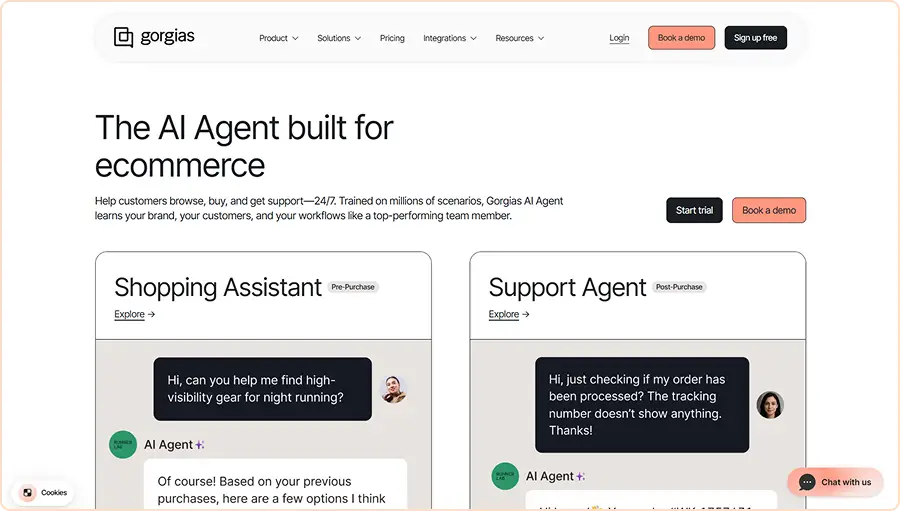
It can answer product questions, recommend items, track orders, manage returns and refunds, and resolve common customer requests. The AI agent learns from a brand’s knowledge base, policies, and workflows to provide accurate, on-brand responses.
Key Features:
- Customer support automation
- Brand-specific responses
- eCommerce integrations
- Action-based automation
- Performance analytics
Best For:
- Post-purchase support: Handles order tracking, returns, refunds, subscription changes, and order edits using live Shopify data.
- Pre-purchase assistance: Answers product questions, recommends items, and guides shoppers through checkout.
- Repetitive queries: Automates common support requests across email, chat, and SMS, reducing the workload on support teams.
Watch Out For:
- Higher AI usage costs
- Additional interaction fees
- Limited private data access
- Short custom tone settings
- Best for routine queries
Pricing:
- Starter: $10/month
- Basic: $60/month
- Pro: $360/month
- Advanced: $900/month
2. Ada
Ada AI Agent is an AI-powered customer experience platform that helps businesses automate customer support across multiple channels. It uses AI to understand customer requests, resolve conversations, and take actions without relying on constant human involvement.

It helps businesses handle customer inquiries, provide personalized support, automate repetitive tasks, and improve service quality over time. Ada can be customized with business knowledge, workflows, and policies to deliver accurate responses across different industries and languages.
Key Features:
- Automated customer support
- Omnichannel conversations
- Multilingual support
- Workflow automation
- AI agent training and optimization
- Enterprise integrations
- Safety and accuracy controls
Best For:
- Large-scale customer support: Handles high volumes of customer inquiries while reducing the workload on human agents.
- Multichannel support: Manages customer conversations across chat, email, voice, and SMS in multiple languages.
- Complex industries: Supports businesses in finance, insurance, retail, travel, hospitality, and gaming.
- Secure customer interactions: Offers enterprise-level security and compliance for businesses handling sensitive customer data.
Watch Out For:
- Thin analytics
- High annual cost
- Hidden pricing
Pricing: Doesn’t publish public pricing tiers
3. Lyro
Lyro AI Agent is an AI-powered customer service agent from Tidio that helps businesses automate customer support while maintaining a personalized experience.
It learns from a company’s support content and uses that information to answer customer questions accurately.
Lyro can handle common support requests, recommend products, provide order updates, qualify leads, and assist customers across different conversations.
Businesses can customize their tone, rules, and escalation settings to match their brand and allow human agents to step in when needed.
Key Features:
- AI-powered customer support
- Knowledge-based responses
- Product recommendations
- Automated order updates
- Lead qualification
- Custom AI guidance
- Human handoff controls
- Performance monitoring
- Third-party integrations
Best For:
- eCommerce support: Handles order tracking, delivery updates, returns, refunds, and product availability questions.
- Quick AI training: Learns from existing website content, FAQs, and help-center articles without manual bot setup.
- Multilingual support: Responds to customers in more than 10 languages.
- Omnichannel communication: Manages conversations across website chat, WhatsApp, Instagram, and Facebook Messenger.
Watch Out For:
- Inconsistent answers:
- Limited customization
- Setup glitches
Pricing:
- Free: $0/month
- Starter: $24.17/month
- Growth: $49.17/month
- Plus: $300/month + usage
- Premium: Custom pricing
4. Sierra
Sierra AI Agent is a conversational AI platform that helps enterprises create and manage AI agents for customer interactions. It enables businesses to automate conversations across channels like chat, voice, SMS, WhatsApp, and email while delivering personalized support.

The platform can understand customer context, complete tasks, and guide users toward specific outcomes instead of only answering questions. Businesses can build agents using their own processes, optimize performance through analytics, and connect them with existing systems to handle complex workflows.
Key Features:
- Multichannel customer support
- AI agent creation and customization
- Workflow automation
- Customer context and memory
- Task-based conversations
- Agent performance analytics
- AI-powered optimization
- Enterprise integrations
- Security and compliance controls
Best For:
- Task completion: Connects with business systems to complete tasks such as changing subscriptions, managing deliveries, and booking appointments.
- Retail and eCommerce support: Handles product returns, order-related requests, and subscription management.
- Complex industries: Supports workflows in insurance, banking, healthcare, home lending, and telecommunications.
Watch Out For:
- Complex setup
- High cost
- Bug issues
Pricing: Sierra doesn’t publish a price list.
5. REP AI
REP AI Agent is an AI-powered commerce solution built for eCommerce sales and customer support. It helps online stores engage shoppers, answer questions, recommend products, and resolve support requests across multiple channels.
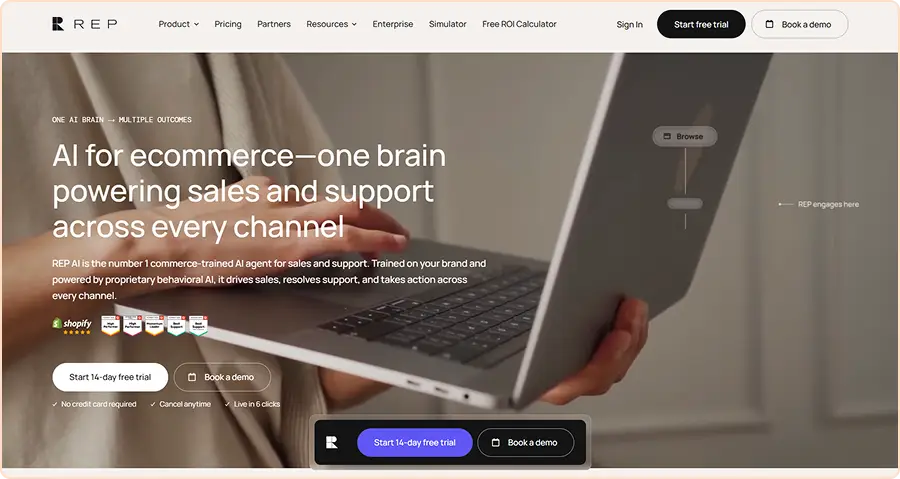
It uses shopper behavior, product data, and brand knowledge to start relevant conversations, guide purchasing decisions, and automate customer interactions.
REP AI can detect buying intent, provide personalized recommendations, handle post-purchase support, and turn customer conversations into insights for improving sales and operations.
Key Features:
- AI-powered product discovery
- Conversational shopping assistance
- Personalized product recommendations
- Order tracking and return management
- Multi-channel customer engagement
- Sales and support automation
- Shopper behavior insights
- AI-driven upselling and cross-selling
- eCommerce integrations
Best For:
- Proactive product recommendations: Engages shoppers who hesitate, compare products, or are about to leave, then suggests relevant items.
- Routine customer support: Handles order tracking, returns, cancellations, and FAQs around the clock, with live-agent handoff.
- Multilingual support: Responds in shoppers’ languages, including for product and sizing questions.
Watch Out For:
- Slow full setup
- Expensive extras
- Limited widget customization
Pricing:
- Sales: $578/month
- Support: $250/month
- Sales + Support: $726/month
(All prices are based on 80,000 sessions per month.)
6. Fin
Fin is an AI customer service agent developed by Intercom that answers customer queries and automates support, sales, and eCommerce tasks.
It uses a company’s knowledge base and customer data to answer questions, resolve issues, and provide personalized support across multiple channels.

Fin integrates with Intercom’s helpdesk to handle customer conversations, assist support teams, and improve responses over time. It can manage common queries, provide instant answers, route complex issues to human agents, and use conversation insights to improve customer experience.
Key Features:
- AI-powered customer support
- Omnichannel conversations
- Human agent collaboration
- AI-assisted ticket management
- No-code workflow automation
- Self-improving AI system
- Third-party integrations
- Automated quality monitoring
Best For:
Omnichannel support: Handles customer conversations across chat, email, phone, social, SMS, Slack, and WhatsApp
Sales and lead management: Qualifies leads, answers pricing questions, books meetings, updates CRM records, and re-engages potential buyers.
Routine ticket resolution: Answers common customer questions using help articles and knowledge base content.
Watch Out For:
- Below-average setup score
- Accounts blocked without warning
- Knowledge base crawling limits
Pricing:
- Fin with current helpdesk: $0.99 per outcome (50 outcomes/month minimum).
- Fin with Intercom helpdesk: $0.99 per outcome + $19 per helpdesk seat/month.
7. CoSupport AI
CoSupport AI is an AI-powered customer support automation platform designed to help businesses automate customer conversations, reduce support workload, and improve response times.

It learns from a company’s existing support tickets, knowledge base, and customer data to provide accurate responses across chat, email, social media, and helpdesk platforms. CoSupport AI can resolve repetitive queries, assist human agents, translate conversations, and provide customer insights to improve support operations.
The platform integrates with popular helpdesk tools (Zendesk, Freshdesk, Zoho Desk) and allows businesses to create AI agents without coding. It focuses on reducing ticket volume, improving resolution speed, and scaling customer support without increasing team size.
Key Features:
- AI-powered customer support automation
- AI agents trained on historical support data
- Automated ticket resolution
- AI assistant for human support agents
- Multichannel customer conversations
- Multilingual support
- Helpdesk integrations
- No-code AI setup
Best For:
- Human agent assistance: Suggests replies to support agents alongside its autonomous AI agent.
- Conversation insights: Analyzes support chats to identify trends and generate business insights.
- Multichannel support: Handles conversations across chat, email, and social media.
Watch Out For:
- Inconsistent pricing
- Hard team onboarding
- Tedious setup and tuning
Pricing:
- AI Customer Support: $0.50 per resolved ticket
- CoSupport AI Assistant: $0.04 per AI response
8. Decagon
Decagon is an AI-powered customer service platform that helps businesses build, optimize, and scale AI agents to deliver personalized customer experiences across chat, voice, and email channels.

It uses Agent Operating Procedures (AOPs), which allow teams to define AI agent workflows in natural language instead of complex configurations. Decagon helps businesses create AI agents, test and improve their performance, and analyze conversations to continuously enhance customer interactions.
The platform acts as an AI concierge that handles customer conversations, resolves requests, maintains context across channels, and works alongside enterprise teams to provide faster and more personalized support.
Key Features:
- AI-powered customer concierge agents
- Omnichannel support across chat, voice, and email
- Natural language agent workflow creation (AOPs)
- Personalized customer interactions
- AI agent testing and optimization
- Conversation analytics and insights
- Continuous AI improvement
Best For:
- Personalized responses: Learns from a business’s knowledge base and past customer conversations to provide relevant answers instead of canned replies.
- Custom workflows: Lets teams create workflows and connect existing knowledge bases and customer experience tools.
- Support analytics: Tags conversations, detects anomalies, identifies trends, and recommends knowledge base updates.
Watch Out For:
- Unclear contract terms
- Immature features
- Limited customization
Pricing: Decagon doesn’t list any prices publicly.
9. Yuma AI
Yuma AI is an AI-powered customer experience automation platform built for eCommerce brands to automate customer support, sales conversations, and social interactions across the entire customer journey.
It uses AI agents that connect with helpdesks, eCommerce platforms, and customer data to resolve support requests, answer product questions, process returns, track orders, manage subscriptions, and take real actions instead of only sending replies.
Yuma AI learns from past conversations, brand knowledge, and support workflows to provide accurate responses while maintaining the brand’s voice.
The platform helps eCommerce teams reduce ticket volume, improve response times, increase conversions, and scale customer service without adding more support staff.
Key Features:
- AI-powered customer support automation
- eCommerce-focused AI agents
- Automated order tracking, returns, refunds, and cancellations
- Pre-purchase sales assistance
- Social media conversation automation
- Product recommendations and upselling
- Helpdesk and eCommerce integrations
Best For:
- eCommerce specialization: Focuses exclusively on eCommerce customer support, with merchants praising its specialized approach to automation.
- Full ticket resolution: Handles refunds, cancellations, returns, and subscription changes instead of simply deflecting tickets or passing them to human agents.
- Omnichannel support: Handles customer inquiries across email, chat, SMS, social media, contact forms, and help centers.
Watch Out For:
- Integration gaps:
- Frustrating early setup
- Occasional hallucinations
Pricing:
- Starter: $14,400/year
- Growth: $40,000/year
- Scale: $90,000/year
10. Zendesk
Zendesk AI Agents are self-improving AI customer service agents designed to help businesses automate support conversations, resolve complex requests, and improve customer experiences across messaging, email, and voice channels.

They use existing business knowledge, policies, and customer data to understand customer intent, complete multi-step workflows, and take actions across connected systems. Powered by a Resolution Learning Loop, Zendesk AI Agents learn from every interaction and continuously improve their accuracy and resolution capabilities over time.
The platform works with Zendesk’s customer service ecosystem to help support teams automate repetitive tasks, manage complex inquiries, maintain control over AI behavior, and deliver faster resolutions without increasing support workload.
Key Features:
- Self-improving AI customer service agents
- Automated customer issue resolution
- Multi-channel support (chat, email, voice, messaging)
- Complex workflow automation
- AI-powered intent detection and reasoning
- Knowledge-based responses
- System integrations and action execution
- Human agent collaboration
Best For:
- Omnichannel AI agents: Handles customer conversations across messaging, email, and voice while maintaining shared context.
- Multilingual voice support: Voice AI agents support over 60 languages and can switch languages during a call.
- Centralized knowledge access: Connects to external sources such as SharePoint and Google Drive to retrieve relevant information.
Watch Out For:
- Slow, complex setup
- Steep learning curve
- Slow, clunky interface
Pricing:
- Support Team: $19 per agent/month (billed annually)
- Suite Team: $55 per agent/month (billed annually)
- Suite Professional: $115 per agent/month (billed annually)
- Suite Enterprise + Copilot: Custom pricing (contact sales)
11. Zipchat
Zipchat AI is an agentic AI sales and support platform built for eCommerce businesses. It helps online stores automate customer conversations, increase conversions, recover abandoned carts, and provide instant support across multiple channels.

It works across website chat, WhatsApp, Instagram, Messenger, and email to answer customer questions, recommend products, track orders, process refunds, and handle pre-sale and post-sale conversations.
Zipchat learns from store data, product catalogs, and customer interactions to deliver personalized responses and resolve queries without constant human involvement.
Key Features:
- AI-powered eCommerce sales and support agent
- Multi-channel customer conversations
- Product recommendations
- Proactive customer engagement
- Knowledge base automation
- Size and fit recommendations
Best For:
- Sales and product recommendations: Recommends products, runs upsells, offers discounts, and recovers abandoned carts to turn customer chats into sales.
- Routine store support: Handles order tracking, returns, stock checks, cash-on-delivery orders, and FAQs around the clock.
- Social and messaging channels: Manages conversations across live chat, WhatsApp, Instagram, Messenger, and email from one inbox.
Watch Out For:
- Slow support replies
- Setup trouble
- Short trial
Pricing:
- Starter: $64/month ($768/year)
- Pro: $240/month ($2,880/year)
- Scale: $480/month ($5,760/year)
- Scale Plus: $960/month ($11,520/year)
12. Algolia
Algolia is an AI-powered search and discovery platform that helps eCommerce businesses improve product search, recommendations, and shopper experiences. Its Agent Studio provides tools for developers to build and deploy custom AI agents using product data, search capabilities, and external tools.

The platform supports natural-language search, generative AI, agentic commerce, and merchandising. Businesses can use it to launch AI-powered shopping experiences, personalize customer journeys, improve product discovery, and rank results based on what drives conversions.
Key Features:
- Agent Studio
- AI search
- Generative AI
- AI Recommendations
- Analytics and A/B testing
Best For:
- AI shopping platform integration: Sends live product data to Microsoft Copilot, Bing Shopping, and Edge.
- Personalized product discovery: Uses AI ranking and real-time personalization to show relevant products and improve conversions.
- B2B and wholesale search: Supports Shopify B2B, displaying products, prices, and search rankings based on each buyer’s account.
Watch Out For:
- Catalog sync costs
- Needs technical skills
- Steep learning curve
Pricing:
- Free: Free search and recommendations.
- Grow: Free; $0.50 per additional 1,000 searches.
- Grow Plus: Free; $1.75 per additional 1,000 searches.
- Elevate: Custom enterprise pricing.
13. Siena AI
Siena AI is a suite of AI agents built specifically for eCommerce and consumer brands.
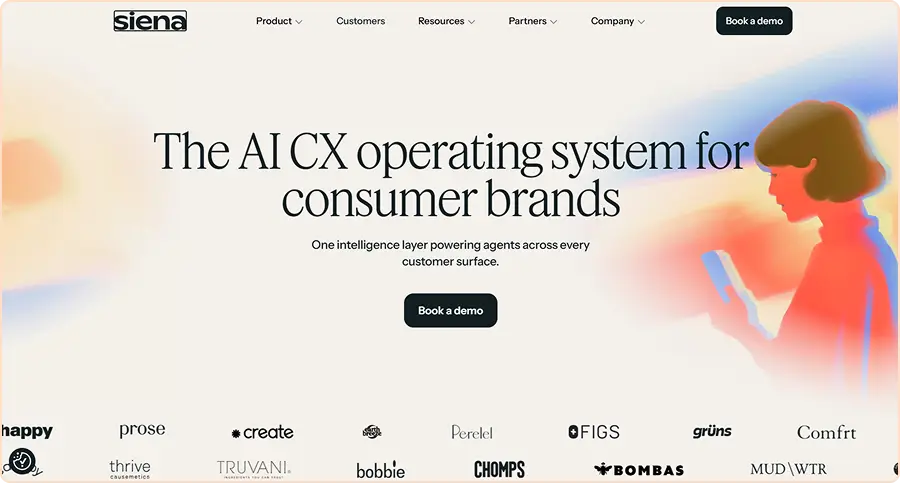
It helps businesses automate customer interactions across online stores and social media while maintaining their brand voice. Its agents can handle customer inquiries, assist with product purchases, and manage post-purchase requests.
Siena also connects AI agents with human support teams and existing business systems, giving both access to shared customer information.
Key Features:
- Shopping Agent
- Customer Service Agent
- Social Agent
- Review Agent
Best For:
- Post-purchase support: Handles order tracking, address changes, returns, refunds, and replacement requests through customer conversations.
- Subscription management: Lets customers skip, pause, or change subscriptions while suggesting alternatives to reduce cancellations.
- Customer experience insights: Analyzes support conversations, reviews, and customer feedback to identify recurring issues and trends.
Watch Out For:
- Drawn-out conversations
- Steep Learning Curve
- Unlisted languages
- Inconsistent AI answers
Pricing: Request a quote.
14. Richpanel
Richpanel is an AI customer support platform and helpdesk built for ecommerce brands. It puts human support agents and AI agents on one platform, so both work from the same customer data, rules, and tools.

Its customers range from small support teams to teams of 100+ agents, and Richpanel says it’s trusted by 3,000+ brands.
Key Features:
- AI assistant for agents
- AI social media moderator
- Customizable reports
- Self-service analytics
Best For:
eCommerce brands with high ticket volumes: Best suited to stores handling frequent order-related queries, including tracking, changes, cancellations, and returns.
Shopify stores: Its AI can take action on Shopify orders, such as updating shipment details, rather than simply sending text responses.
Multi-brand operators: Supports multiple stores in one workspace, with separate AI voices, policies, and reports for each brand.
Watch Out For:
- Slow setup
- Steep learning curve
- Integration issue
- Not user-friendly
Pricing:
- Pro: $69/agent/month
- Pro Max: $99/agent/month
- Enterprise: Custom pricing (for teams with more than 50 agents)
15. eDesk
eDesk AI Agent is an AI-powered customer support tool built for eCommerce businesses that sell across multiple marketplaces and sales channels. It automates customer service by understanding customer queries, retrieving relevant order, product, and policy information, and generating accurate, brand-aligned responses.
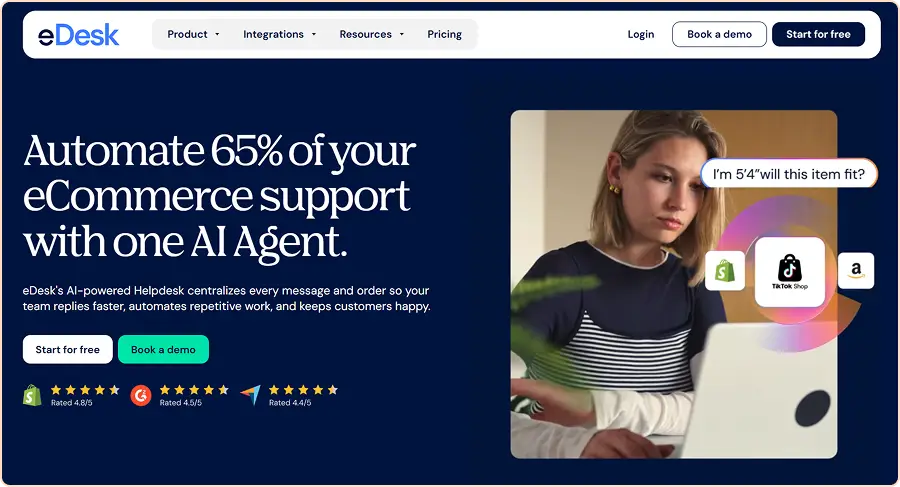
It handles repetitive support requests such as order tracking (WISMO), refunds, returns, cancellations, and troubleshooting. It also answers pre-sale questions about product specifications, compatibility, and shipping to help turn buyer inquiries into sales.
The AI Agent works directly within the eDesk Helpdesk and connects with 300+ marketplaces and channels. It uses approved procedures, confidence thresholds, and guardrails to reduce incorrect or risky responses while helping support teams manage higher ticket volumes.
Key Features:
- Multichannel coverage
- Repetitive query handling
- Intent detection
- Rule-based decisions
Best For:
- Marketplace sellers: Businesses selling on Amazon, eBay, Walmart, Kaufland, Mirakl, or TikTok Shop, where messages arrive through each marketplace’s own system.
- Multichannel sellers: Brands selling through marketplaces and their own Shopify, Magento, or WooCommerce stores that need to manage conversations from one inbox.
- Cross-border sellers: Businesses serving international buyers that need the Translate add-on to respond in different languages across European and global marketplaces.
Watch Out For:
- User interface navigation
- Escalating pricing
- Ticketing issue
Pricing:
(Billed Annually)
- Essential: $45/agent/month + $0.99 per AI outcome
- Growth: $99/agent/month + $0.99 per AI outcome
- Professional: $129/agent/month + $0.99 per AI outcome
- Enterprise: Custom pricing + $0.99 per AI outcome
Comparison of the Best AI Agents
Choosing the right AI customer support agent depends on its features and capabilities. The following comparison highlights the key differences between leading AI agents to help businesses identify the right solution for their customer support needs.
| AI Agent | Best Suited For | Starting Price | Key Capabilities |
| Gorgias | eCommerce customer support | $10/month | Order tracking, returns, refunds, product recommendations, and Shopify integration |
| Ada | Large enterprises | Custom pricing | Omnichannel support, multilingual conversations, workflow automation, and enterprise security |
| Lyro | Small and mid-sized businesses | Free | FAQ automation, order updates, product recommendations, lead qualification, and human handoff |
| Sierra | Complex customer service workflows | Custom pricing | Task completion, subscription changes, appointment booking, and enterprise integrations |
| Rep AI | eCommerce sales and support | $250/month | Product recommendations, upselling, cart recovery, order tracking, and multilingual support |
| Fin by Intercom | Omnichannel customer support | $0.99 per outcome | Automated ticket resolution, lead qualification, CRM updates, and human agent collaboration |
| CoSupport AI | Automated support with human agent assistance | $0.04 per AI response | Ticket resolution, AI-suggested replies, conversation analytics, and multichannel support |
| Decagon | Personalized enterprise support | Custom pricing | Custom AI workflows, knowledge-based responses, conversation analytics, and continuous optimization |
| Yuma AI | eCommerce support automation | $14,400/year | Refunds, returns, order tracking, subscription management, and omnichannel support |
| Zendesk AI Agents | Businesses using an established helpdesk | $19/agent/month | Omnichannel automation, multilingual voice support, knowledge retrieval, and human agent assistance |
| Zipchat | eCommerce sales conversion and support | $64/month | Product recommendations, upselling, abandoned cart recovery, order tracking, and social messaging |
| Algolia | AI-powered product search and discovery | Free | AI search, Agent Studio, personalized product discovery, recommendations, and B2B search |
| Siena AI | eCommerce customer experience automation | Custom pricing | Customer support, shopping assistance, social interactions, and customer insights |
| Richpanel | High-volume eCommerce & Shopify stores | $69/agent/month | Unified inbox, self-service portal, multi-platform apps, smart assignment, direct Shopify actions |
| eDesk | Marketplace & multichannel eCommerce sellers | $45/agent/month + $0.99/outcome | Multichannel coverage, repetitive query handling, intent detection, rule-based decisions |
Also Read: Custom eCommerce Development: Features, Costs, and More
How to Choose the Right AI Agent for Your eCommerce Business
Choosing the right AI agent is about finding a solution that solves your business challenges and delivers measurable results. The ideal platform should fit your workflows, integrate with your existing systems, and scale as your business grows. Before making a decision, consider the following factors.
Define Your Business Goal
Start by identifying the problem you want the AI agent to solve. Your goal may be to reduce customer support tickets, increase sales, recover abandoned carts, automate returns, or improve customer satisfaction.
Having a clear objective helps you choose a solution with the right capabilities and measure its impact after deployment.
Choose the Right Type of AI Agent
Not every AI agent serves the same purpose. Customer-facing AI agents focus on sales and support, operational AI agents automate internal processes like inventory and order management, while marketing AI agents optimize campaigns and customer engagement. Select a solution that aligns with your primary business needs.
Look for eCommerce-Specific Features
A general-purpose AI chatbot may not handle eCommerce workflows effectively. Prioritize AI agents that support product recommendations, order tracking, returns and refunds, subscription management, cart recovery, and personalized shopping assistance. These features provide direct value throughout the customer journey.
Check Integration Capabilities
An AI agent performs best when it can access your business data. Make sure it integrates with your eCommerce platform, CRM, helpdesk, payment gateways, shipping providers, inventory management system, and marketing tools.
Many AI agents prioritize ready-made integrations with platforms like Shopify. If the store runs on a self-hosted codebase, check whether the agent supports REST API connections, webhooks, or an embeddable widget to connect with existing systems.
Evaluate Automation Capabilities
Some AI tools only suggest responses, while others can complete actions independently.
Depending on your requirements, evaluate whether the AI can update orders, process refunds, modify subscriptions, trigger workflows, send follow-up messages, or perform other operational tasks without constant human involvement.
Review Customization Options
Every business has unique workflows, policies, and brand guidelines. Choose an AI agent that allows you to customize conversation flows, brand voice, automation rules, escalation paths, and business logic.
Analyze Reporting and Analytics
Analytics help you understand whether your AI investment is producing results. Look for dashboards that measure automation rates, response times, customer satisfaction, conversion rates, sales generated through AI interactions, and overall ROI.
Consider Scalability and Security
As your business grows, your AI agent should be able to handle increasing conversation volumes without affecting performance.
Also evaluate security features such as data encryption, compliance certifications, access controls, and system reliability to ensure customer information remains protected.
If your AI agent interacts directly with customers, check whether it meets applicable disclosure requirements. For example, Article 50 of the EU AI Act, effective August 2, 2026, requires covered chatbots to inform users that they are interacting with AI. It already applies to any store selling to EU shoppers.
Compare Long-Term Value
Pricing should be evaluated alongside features, integrations, scalability, customer support, and expected business impact. Instead of selecting the cheapest option, choose an AI agent that delivers the highest long-term value through greater automation, improved customer experience, and measurable business outcomes.
Future of AI Agents in eCommerce
AI agents are rapidly evolving from support tools into autonomous business systems. Instead of simply answering customer questions, the next generation of AI agents will make decisions, complete complex tasks, and coordinate multiple business processes with minimal human involvement. As AI models improve and eCommerce platforms become more connected, their role will continue to expand.
More Autonomous Decision-Making
Future AI agents will handle increasingly complex workflows without waiting for human approval. They will process returns, manage subscriptions, adjust inventory, resolve delivery issues, and coordinate multiple systems while following predefined business policies.
Hyper-Personalized Shopping Experiences
AI agents will use customer behavior, purchase history, browsing patterns, and real-time context to deliver highly personalized product recommendations, promotions, and shopping experiences. Every customer interaction will become more relevant and tailored to individual preferences.
Predictive and Proactive Customer Engagement
Rather than waiting for customers to ask questions, AI agents will identify potential issues and opportunities before they happen. They may proactively notify customers about shipping delays, recommend complementary products, remind shoppers about abandoned carts, or suggest subscription renewals at the right moment.
Conclusion
Instead of relying on marketing claims or feature lists alone, use this guide to evaluate AI agents based on what actually matters: automation capabilities, integrations, security, scalability, customer experience, and business impact.
Best AI agents for eCommerce should solve real problems, integrate with your existing eCommerce ecosystem, and generate measurable results. With the insights in this guide, you’re better equipped to compare platforms confidently and choose a solution that helps your eCommerce business grow more efficiently.
FAQs
How much do AI agents for eCommerce cost?
The cost of AI agents for eCommerce typically ranges from $0 to several thousand dollars per month, depending on the agent’s capabilities, integration requirements, usage volume, and level of customization. Most AI agents for eCommerce cost between $100 and $1,500 a month (approximate).
Which AI agent is best for a Shopify store?
The best choice depends on the store’s needs. Gorgias suits customer support and pre-sale queries, while Yuma AI handles high-volume support tasks such as refunds and returns. Rep AI and Zipchat focus on sales and cart recovery, whereas Lyro by Tidio is a good starting point for smaller stores handling common customer queries.
What can AI agents do for an eCommerce store?
AI agents can automate customer support, answer product questions, recommend items, recover abandoned carts, process returns, track orders, manage customer inquiries, and assist with sales and marketing activities.
Can AI agents increase eCommerce sales?
Yes. AI agents can improve sales by providing personalized product recommendations, engaging shoppers at the right moment, answering buying questions instantly, and reducing cart abandonment through proactive conversations.
Can AI agents integrate with eCommerce platforms like Shopify or WooCommerce?
Yes. Many eCommerce AI automation agents connect with popular platforms such as Shopify, WooCommerce, Magento, CRM systems, helpdesks, payment tools, and other business applications to access data and complete tasks.
Do AI agents need access to my business data?
Yes. AI agents perform better when they can access relevant information such as product catalogs, customer history, order details, FAQs, policies, and support conversations. Proper permissions and security controls help protect sensitive data.